Why most AI agents fail the quality test, and how to pass it

Customers don't judge an AI agent by how it sounds in a demo. They judge it by whether their issue got resolved. Getting to resolution at scale takes two things: an AI agent that handles the high-stakes moments correctly, like a payment, an authentication or a caller's correction, and the evidence that it will do so before a real caller ever hears it.
This month's releases focus on both. We're introducing new ways to build tests from real calls, along with a runtime improvement that makes AI agents more reliable on the details that matter most.
Tests built from real conversations
An AI agent is only as good as its testing. Large language models are probabilistic, so you can't know how an AI agent will behave until it's been tested against the situations it will face. The best source of those situations isn't what a team predicts callers will say. It's what callers have already said. Three new capabilities make real conversations the center of how Replicant AI agents are built and validated.
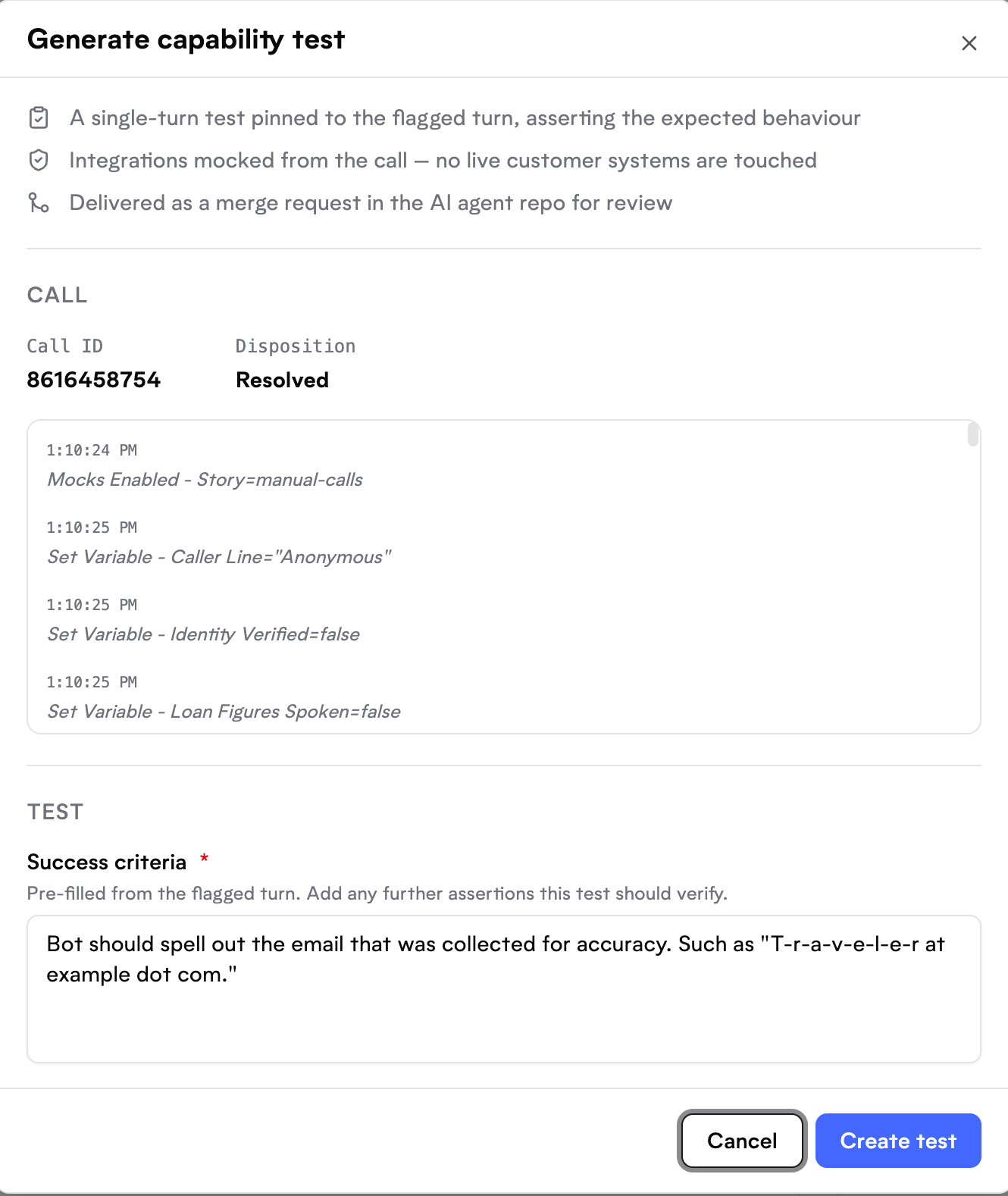
Call-based test generation (beta). Pick any real call and turn it into a test in moments. A call that went well becomes a scenario test that locks that behavior in. A call that went wrong becomes a regression test: mark the point where the conversation went off track, describe what should have happened instead, and the AI agent is held to that standard from then on. Because tests come from real callers, they capture the phrasings, interruptions and edge cases that hand-written test plans miss.
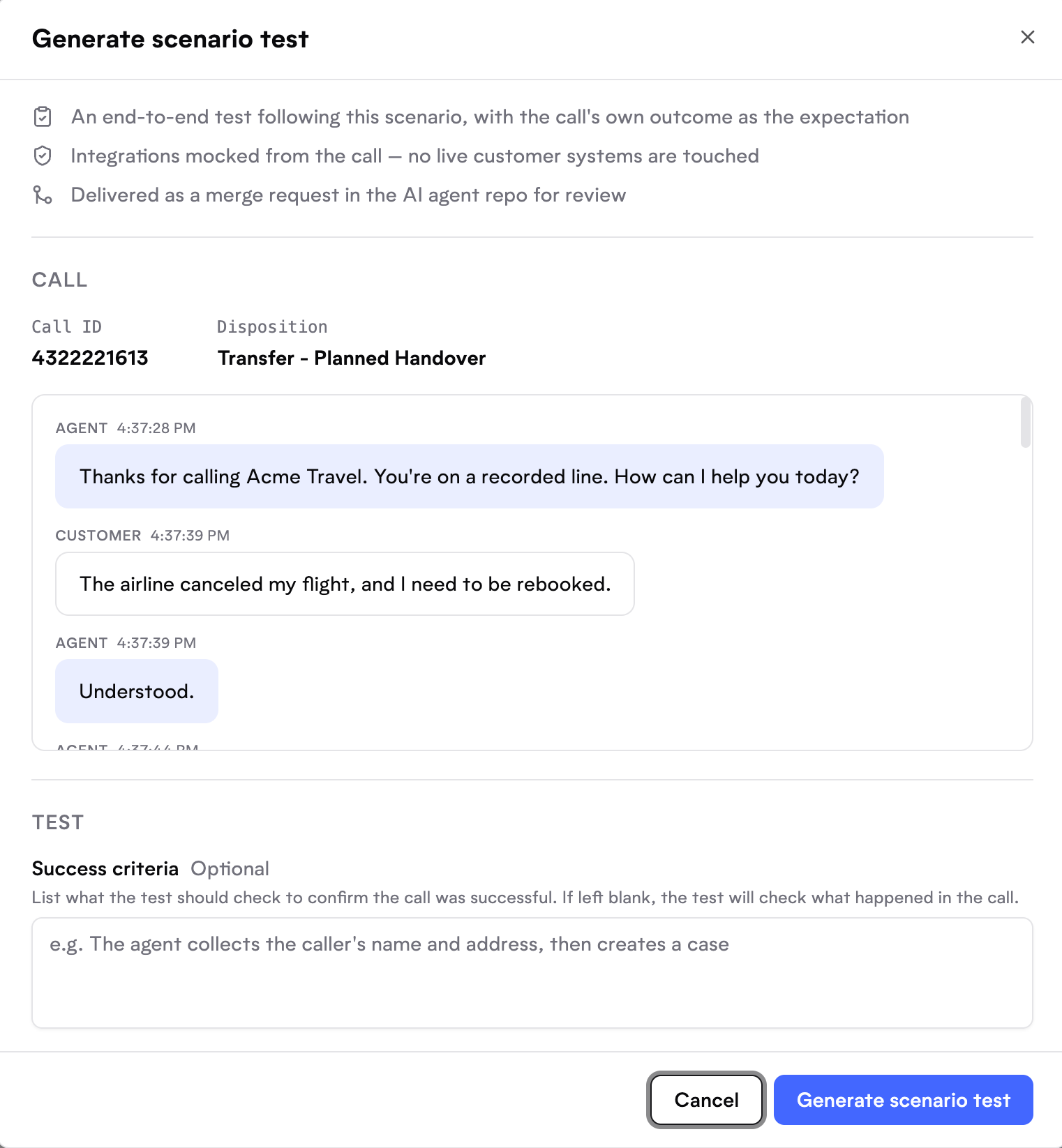
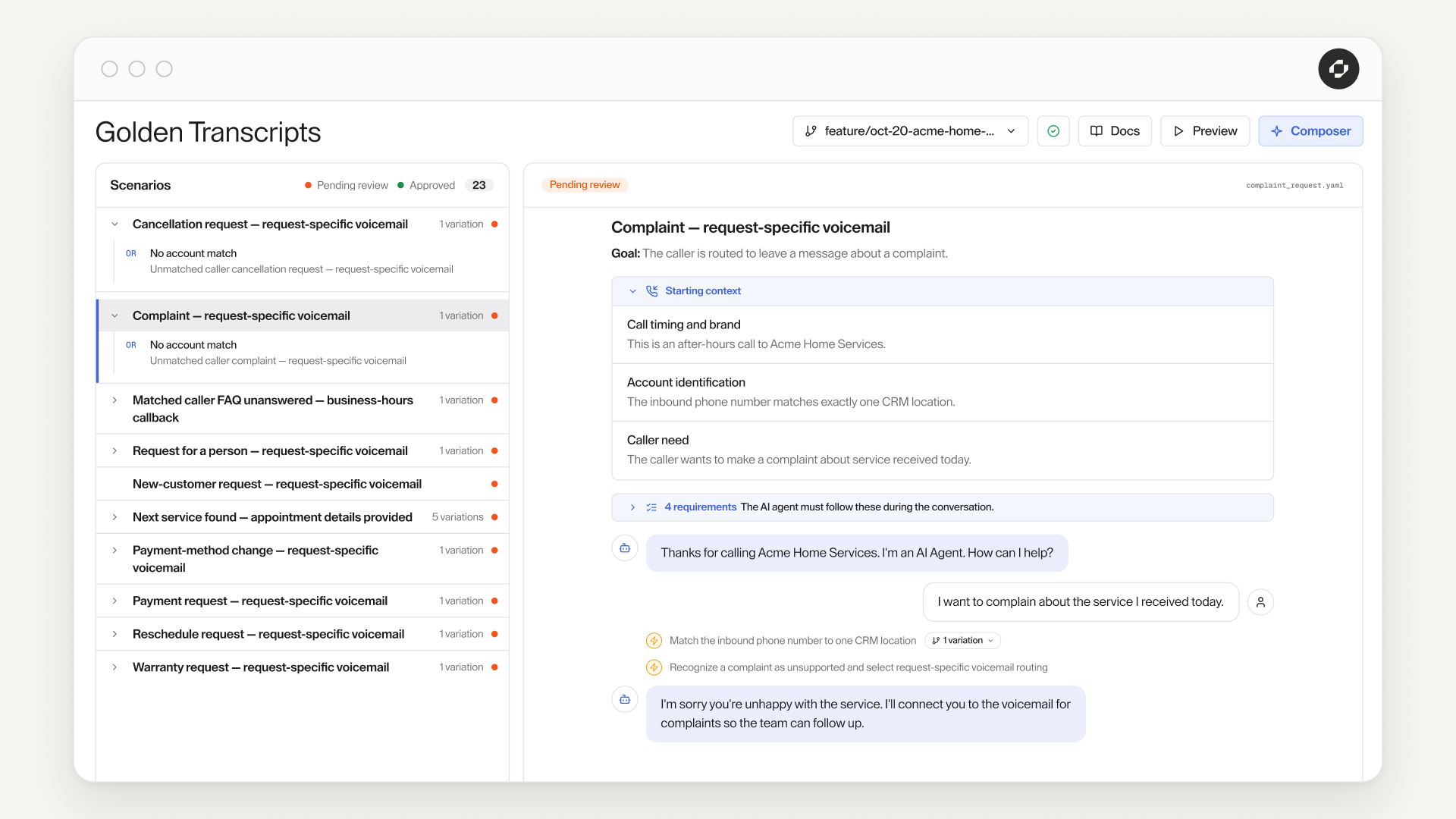
Evaluation-driven development. Think about how a contact center onboards a new hire. A trainer sits down with them, listens to a real call together, and walks through what to say and do at each step. Eval-driven development brings that same approach to AI agents: call shadowing for AI. Replicant and the customer work side by side to write the conversation they agree is perfect for each scenario, adjusting the greeting, the order of steps and the responses until it's right. Once signed off, these become the golden transcripts, or in other words, the scenario tests the AI agent must pass before it goes live, so everyone shares the same definition of good from day one.
Automatic test maintenance. As AI agents evolve, tests can break for reasons that have nothing to do with the AI agent's behavior, and a broken test can hold up a needed change. New tooling identifies those issues and fixes them automatically, so test suites stay healthy as they grow and teams can keep adding coverage instead of spending time on upkeep.
Together, these build on Automated Simulations and extend Replicant's AI-building-AI approach. The same conversation data used to build an AI agent is used to prove it works, your team stays in the loop to define what good looks like, and every test is visible. There's no black box between the demo and go-live. Next, we’re bringing human agent conversations into the mix, so your AI agent can learn from your best people the same way a new hire does.
What this means for your contact center
Every release this month serves the same goal: bringing customers better and higher-quality AI agents that are tested across multiple scenarios that are based on existing conversations, and that keep learning throughout the process. That means faster launches with fewer surprises and AI agents that handle sensitive workflows with the precision regulated industries require.
Want to see these updates in action? Request a demo and our team will walk you through them.